Mapping the Global Energy Transition
Independent, quantitative analysis of the technologies, market mechanisms, and policy structures required to decarbonize the global power sector by 2050.

Key Metrics: The Scale of the Challenge
The Generation Mix Pivot
Decarbonizing the grid requires moving from dispatchable, fuel-based generation to variable renewable energy (VRE) sources, supported by firm low-carbon technologies like nuclear, geothermal, and long-duration storage.
The pace of deployment for solar PV and wind has accelerated, but grid integration challenges and supply chain bottlenecks present significant friction. The LCOE (Levelized Cost of Energy) for renewables has fallen below incumbent fossil assets in many regions, shifting the economic argument permanently.
Global Generation Additions by Technology (2023)
| Technology | Capacity Added (GW) | Share (%) |
|---|---|---|
| Solar PV | 420 | 73% |
| Wind (Onshore & Offshore) | 117 | 20% |
| Hydropower | 15 | 3% |
| Other Renewables | 10 | 2% |
| Nuclear | 5 | 1% |
Source: IEA Renewables 2023 Report (Estimates). Note: Capacity does not equal generation due to capacity factors.
Interactive: LCOE Calculator
Simplified Levelized Cost of Energy
Calculate the baseline cost of generating electricity for a hypothetical project.
The Transmission Bottleneck
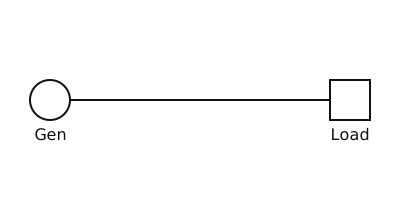
High-voltage transmission infrastructure is the single largest physical barrier to the energy transition. Renewable resources are geographically constrained, often located far from demand centers. Building new lines faces severe permitting, regulatory, and public acceptance hurdles.
Technologies like High-Voltage Direct Current (HVDC) and Advanced Conductors are essential to maximize right-of-way capacity and connect asynchronous grids over long distances.
Energy Storage Integration
Variable generation necessitates flexible resources to balance supply and demand on second-by-second to seasonal timescales. Lithium-ion batteries dominate short-duration storage, while pumped hydro and emerging technologies target longer durations.
Li-Ion Batteries
Dominates 2-4 hour duration market. Capital costs have plummeted 80%+ over the last decade.
Read morePumped Hydro
Accounts for >90% of global installed storage capacity, but geologically constrained.
Read moreHydrogen & Synfuels
Critical for seasonal storage and decarbonizing hard-to-abate industrial sectors.
Read morePolicy & Market Design
Common Market Mechanisms
- Carbon Pricing: Cap-and-trade systems (e.g., EU ETS) or carbon taxes.
- Capacity Markets: Paying generators for availability, not just energy delivered.
- Feed-in Tariffs (FiT): Fixed rate payments for renewable generation.
- Contracts for Difference (CfD): Stabilizing revenues by paying/clawing back the difference from a strike price.
Wholesale electricity markets designed around marginal cost pricing struggle when zero-marginal-cost renewables dominate the grid, leading to price cannibalization. Market redesign is urgently needed to properly value flexibility, capacity, and ancillary services.
Frequently Asked Questions
Research & Data Center
Explore our underlying datasets, glossaries, and methodologies.
The Geopolitics of Critical Minerals
The transition from fossil fuels to clean energy represents a shift from a fuel-intensive energy system to a material-intensive one. Lithium, cobalt, nickel, and rare earth elements are now critical to global energy security.
Current supply chains are highly concentrated, with China controlling over 70% of battery cell manufacturing and significant shares of mineral processing.
Read the Policy BriefProcessing Market Share (2023)
| Mineral | China | Rest of World |
|---|---|---|
| Copper | 40% | 60% |
| Lithium | 58% | 42% |
| Cobalt | 65% | 35% |
| Rare Earths | 87% | 13% |
Grid Integration & Flexibility
Demand Response
Shifting load to match generation, rather than generation to match load. Critical for managing peak EV charging.
Read MoreV2G Technology
Vehicle-to-grid allows the massive battery capacity of the EV fleet to act as distributed grid storage.
Read MoreSynchronous Condensers
Legacy fossil generators converted to provide vital grid inertia and voltage support without burning fuel.
Read MoreIndustrial Decarbonization
While the power sector is the easiest to decarbonize, heavy industry (steel, cement, chemicals) requires entirely new processes. Green hydrogen and Carbon Capture and Storage (CCS) are the primary technological pathways for these hard-to-abate sectors.
The Nuclear Debate: SMRs vs Gigawatt Scale
Advanced nuclear is critical for deep decarbonization due to its high capacity factor and firm generation profile. While gigawatt-scale projects in the West face paralyzing cost overruns, Small Modular Reactors (SMRs) promise to shift construction from the field to the factory.
However, SMRs sacrifice economies of scale. First-of-a-kind (FOAK) deployments still require massive government subsidies, and supply chains for High-Assay Low-Enriched Uranium (HALEU) fuel remain constrained.
Global Nuclear Capacity Under Construction (2023)
| Region | GW Under Construction |
|---|---|
| China | 30.3 GW |
| India | 6.0 GW |
| Russia | 3.1 GW |
| Europe | 5.4 GW |
| United States | 0.0 GW (Vogtle complete) |
The Electrification of Everything
Decarbonizing the power sector is only step one. Step two involves electrifying end-uses currently reliant on direct fossil fuel combustion, dramatically expanding the size of the power grid.
Electric Vehicles (EVs)
Passenger EVs are scaling rapidly, but integrating millions of mobile batteries into the grid requires managed charging and potential V2G support to avoid massive local distribution upgrades.
Read More on V2GHeat Pumps
Heat pumps offer coefficients of performance (COP) over 3.0, making them highly efficient for space heating. They will massively increase winter peak loads, shifting grids from summer-peaking to winter-peaking.
Read More on Peak DemandEnergy Efficiency: The First Fuel
The cheapest megawatt is the one you never generate. Energy efficiency measures, from industrial motor upgrades to building envelope retrofits, offer the lowest LCOE of any resource.
Despite the strong economic fundamentals, energy efficiency suffers from split incentives (e.g., landlords buy the equipment, tenants pay the utility bill) and high transaction costs for small-scale projects.
Explore Efficiency Policies